

Kraków is developing a space technology ecosystem
Kraków is making its presence felt ever more clearly on the map of the European space sector. The city is home to universities and research teams, technology companies, business support organisations and specialists who develop skills relevant to this sector. This potential lays the foundations for building a strong local space ecosystem, the further development of which requires ever closer collaboration between science, business and public administration. The potential uses of these resources were also discussed during the conference held alongside the European Rover Challenge 2026.

Kraków is building its expertise for the space sector
Kraków has a strong foundation for the development of the space sector. One of its key strengths is the city's strong academic and research base, comprising primarily the AGH University of Science and Technology and the Jagiellonian University. AGH is expanding its activities through the Faculty of Space Technologies and the Space Technologies degree programme, which trains specialists for this growing market. In the meantime, researchers from the Jagiellonian University are participating in research projects conducted on the International Space Station, and the university is carrying out research in such fields as astronomy, space physics and data processing. The other universities in Kraków are also involved in developing expertise in the space sector, including the Kraków University of Technology and the University of Agriculture, which are working on projects related to telecommunications, materials engineering, Earth observation, etc.
Innovation, entrepreneurs and technological infrastructure
The city’s potential is enhanced by the presence of companies developing technologies used in the space sector. There are companies in Kraków conducting projects for the European Space Agency, as well as organisations which are working on solutions related to satellite data, artificial intelligence and advanced data analysis. Companies mentioned as part of this ecosystem include, for instance: Creotech, Liftero, Orbify and 6ROADS.
The Kraków Technology Park also plays a significant role, supporting the development of innovative technological ventures and the commercialisation of new solutions. Kraków is also home to the FORT Kraków centre and the NATO DIANA accelerator; these bring together projects in the field of dual-use technologies.
Research and computing infrastructure also contributes to the sector’s development. The city has the resources to conduct projects which require advanced computing power and the use of artificial intelligence. In this context, what may also play an important role is the Gaia AI Factory, supporting projects at the intersection of AI and space technology.
Cooperation as the next stage of development
Today, Kraków not only has the scientific and technological infrastructure required for the development of the space sector, but also an environment conducive to bringing together the expertise of various organisations. This is achieved through initiatives bringing together entrepreneurs, universities, institutions and young talents. One of these is the Startup Kraków platform, initiated by the City of Kraków and developed by OMGKRK, the Kraków City of Startups Foundation, the Kraków Technology Park, Startup Poland, the Kraków LifeScience Cluster and the Jagiellonian Centre for Innovation; together, they support entrepreneurship and the development of the local innovation ecosystem. However, directly linked to the space sector is the "Kraków – Space City" agreement, entered into in 2025; it aims to bring together stakeholders interested in the development of space technologies in the city.
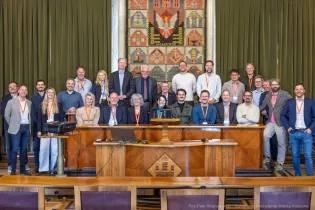
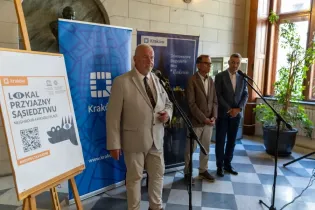
That being said, the challenge lies not only in developing this potential, but above all in making effective use of it. This topic was brought up during the conference held alongside the European Rover Challenge 2026. During the "Kraków the Next City Space" panel discussion, representatives of academia, business and public administration discussed the city’s potential, available talents and vectors of the development of the local ecosystem: Dr Joanna Pyrkosz-Pacyna, Vice-Dean for Development and Cooperation at the Faculty of Space Technologies, AGH University of Science and Technology; Dr Wojciech Regulski, Eng., from Symkom; Dr Jacek Strzelczyk, CEO of SATIM; Radek Zaleski, Head of Marketing at CloudFerro; Andrzej Bańka, Deputy Director of the Department of Ownership Supervision and Economic Management at the Marshal’s Office of the Małopolska Voivodeship; and Izabela Górska, an expert on cooperation with start-ups and business at the Department of Entrepreneurship and Innovation of Kraków City Council.
From this perspective, establishing Kraków’s position as a space city does not mean creating yet another, separate industry from ground up. The aim is to make use of the expertise that is already being developed in the city – in the fields of science, technology, business and institutions – and to create an environment in which these areas can complement one another and lead to joint ventures. In this context, the conclusion was reached that Kraków would become a true space city when the various organisations stopped operating in isolation and started working together as a single team.