

Plac Centralny i Aleja Róż
| Kategoria: | Nowa Huta na Europejskim Szlaku Kulturowym ATRIUM |
| Adres: | Aleja Róż, Kraków |
Plac Centralny i Aleja Róż (1952−1956, proj. Janusz Ingarden i Tadeusz Ptaszycki)
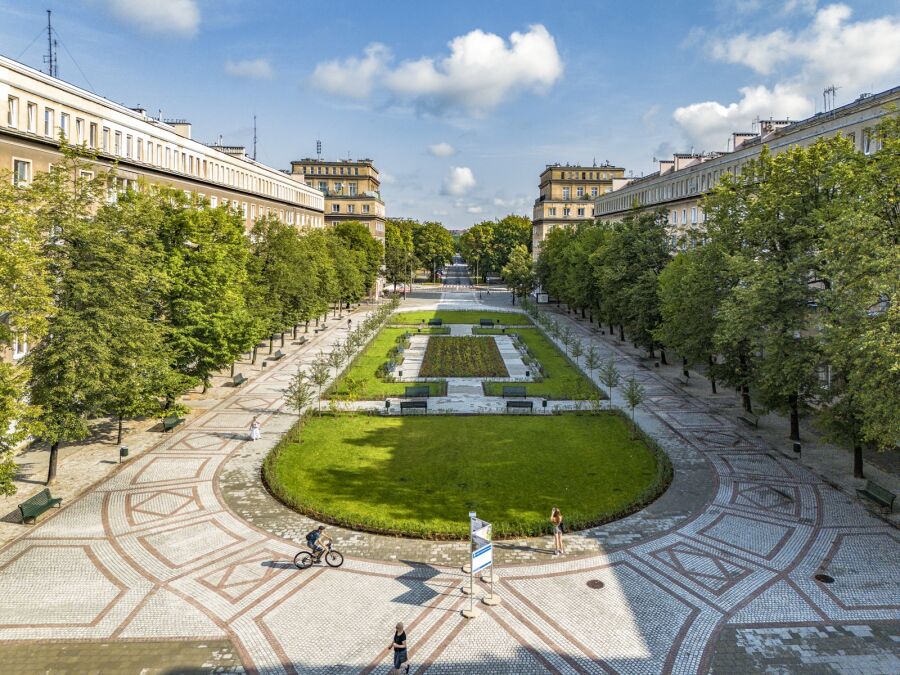
Plac Centralny – serce Nowej Huty – to sztandarowy przykład urbanistyki socrealistycznej w Polsce, zaprojektowany jako monumentalne zwieńczenie centralnego założenia dzielnicy. Powstał w latach 1952–1956 jako centralny węzeł założenia urbanistycznego, z którego promieniście rozchodzi się pięć szerokich alei, dzielących dzielnicę na cztery sektory mieszkaniowe (A–D). Plac, ukształtowany na planie pięcioboku, został usytuowany na krawędzi skarpy wiślanej i otoczony reprezentacyjną zabudową z wysokimi arkadami, porte-fenêtre, balustradami z tralkami i wysuniętymi ryzalitami – w duchu renesansu i klasycyzmu francuskiego. Wnętrza zaprojektowane m.in. przez Mariana Sigmunda dopełniały idei pałacowego monumentalizmu, charakterystycznego dla realizmu socjalistycznego. Przedłużeniem założenia jest Aleja Róż – zaplanowana jako główna oś kompozycyjna Nowej Huty, prowadząca do niezrealizowanego rynku z ratuszem. W 1973 roku ustawiono tu monumentalny pomnik Lenina autorstwa Mariana Koniecznego – przez lata centralny punkt propagandowych uroczystości, który został usunięty w grudniu 1989 jako symboliczny akt końca epoki. W 2023 roku zakończyła się modernizacja fragmentu Alei Róż, która przywróciła mu pierwotny wygląd z lat 50. XX wieku. Zabudowa otaczająca plac i aleję to efekt współpracy czołowych polskich architektów epoki i realizacja idei „miasta idealnego” – z podziałem na sektory (A–D), samowystarczalne osiedla z pełną infrastrukturą, powiązane osiami komunikacyjnymi i podporządkowane jednej, spójnej wizji przestrzennej i politycznej. Pomimo rozmachu, projekt nie został w pełni zrealizowany – nie powstały planowane dominanty: teatr przy skarpie, obelisk na środku placu i ratusz z wysoką iglicą, który miał zamykać perspektywę Alei Róż.
[ENGLISH]
Plac Centralny and Aleja Róż (1952−1956, designed by Janusz Ingarden and Tadeusz Ptaszycki)
Central Square – the heart of Nowa Huta – is the flagship example of socialist realist urbanism in Poland, designed as a monumental crowning achievement of the district's central premise. It was built between 1952 and 1956 as the central node of an urban establishment from which five broad avenues radiate, dividing the district into four residential sectors (A-D). The square, designed on a pentagonal plan, was situated on the edge of the Vistula escarpment and surrounded by representative buildings with high arcades, porte-fenêtre, balustrades with balusters and protruding avant-corps in the spirit of Renaissance and French classicism. The interiors, designed by Marian Sigmund among others, complemented the idea of palace monumentalism, characteristic of socialist realism. An extension of the premise is the Avenue of the Roses, planned as the main compositional axis of Nowa Huta, leading to an unrealised market with a town hall. In 1973, a monumental statue of Lenin by Marian Konieczny was erected here – for years the focal point of propaganda celebrations – which was removed in December 1989 as a symbolic act of the end of an era. In 2023, the upgrade of a section of the Avenue of the Roses was completed, restoring it to its original 1950s appearance. The buildings surrounding the square and avenue are the result of the collaboration of leading Polish architects of the era and the realisation of the idea of the 'ideal city' - divided into sectors (A-D), self-sufficient settlements with full infrastructure, linked by communication axes and subordinated to a single, coherent spatial and political vision. Despite the momentum, the project was not fully realised – the planned cornerstone structures were not built: the theatre by the escarpment, the obelisk in the middle of the square and the town hall with its tall spire, which was to close off the perspective of Avenue of the Roses.
[ITALIANO]
Plac Centralny (piazza Centrale) e Aleja Róż (viale delle Rose) (1952–1956, progetto di Janusz Ingarden e Tadeusz Ptaszycki)
Plac Centralny – cuore di Nowa Huta – è l’esempio emblematico dell’urbanistica del realismo socialista in Polonia, concepito come coronamento monumentale dell’impianto centrale del quartiere. Fu realizzato tra il 1952 e il 1956 come nodo centrale dell’impianto urbanistico, da cui si diramano cinque ampi viali che suddividono il quartiere in quattro settori residenziali (A–D). La piazza, dalla pianta pentagonale, fu collocata sul ciglio della scarpata della Vistola ed è circondata da edifici rappresentativi con alti portici, porte finestre, balaustre con colonnine e risalti aggettanti – nello spirito del Rinascimento e del classicismo francese. Gli interni, progettati tra gli altri da Marian Sigmund, completavano l’idea di un monumentalismo palaziale, caratteristico del realismo socialista. Il prolungamento dell’impianto è costituito da Aleja Róż, concepita come l’asse compositivo principale di Nowa Huta, che avrebbe dovuto condurre a una piazza del mercato con municipio mai realizzata. Nel 1973 vi fu eretta la monumentale statua di Lenin, opera di Marian Konieczny, che per anni costituì il punto focale delle celebrazioni propagandistiche e fu rimossa nel dicembre 1989 come atto simbolico della fine di un’epoca. Nel 2023 è stata completata la riqualificazione di un tratto di Aleja Róż, che le ha restituito l’aspetto originario degli anni Cinquanta. I fabbricati che circondano la piazza e il viale sono il risultato della collaborazione dei principali architetti polacchi dell’epoca e della realizzazione dell’idea di “città ideale” – suddivisa in settori (A–D), con complessi residenziali autosufficienti dotati di infrastrutture complete, collegati da assi viari e subordinati a un’unica, coerente visione spaziale e politica. Nonostante l’ambizione, il progetto non fu mai pienamente realizzato: non sorsero le previste dominanti architettoniche – il teatro presso la scarpata, l’obelisco al centro della piazza e il municipio con la sua alta guglia, che avrebbe dovuto chiudere la prospettiva di Aleja Róż.